How to find a VPN free trial with no credit card in 2026
Discover how to access a VPN free trial without a credit card in 2026. practical steps, caveats, and legitimate options to try risk-free before subscribing.
A vpn free trial no credit card looks simple until you hit the edge cases that testers ignore. Most free trials hide data caps or automatic upgrades behind the fine print, and that trap costs you real time. You’ll want to see the exact trial length, data limits, and how cancellation works before you sign anything.
This piece cuts through the hype by tracing what actually qualifies as risk-free access in 2026, with the practical checks you can perform from day one. Industry reports point to hidden limits in as many as half of no-cc offers, and reviews consistently note that a clean no-cc path is rare. We map the common failure modes, the verified no-cc paths, and the red flags you should screen for before you commit.
The plain definition of VPN free trials without a credit card
A no-credit-card VPN free trial is exactly what it sounds like: you get access to a VPN service without handing over your payment details. You’re allowed to use the app for a defined window or with a capped feature set, and you can decide to keep or ditch the plan before you’re billed.
I dug into the common formats and what they actually grant. In 2026, you’ll see three mainstream patterns, with subtle trade-offs you should spot before you sign up.
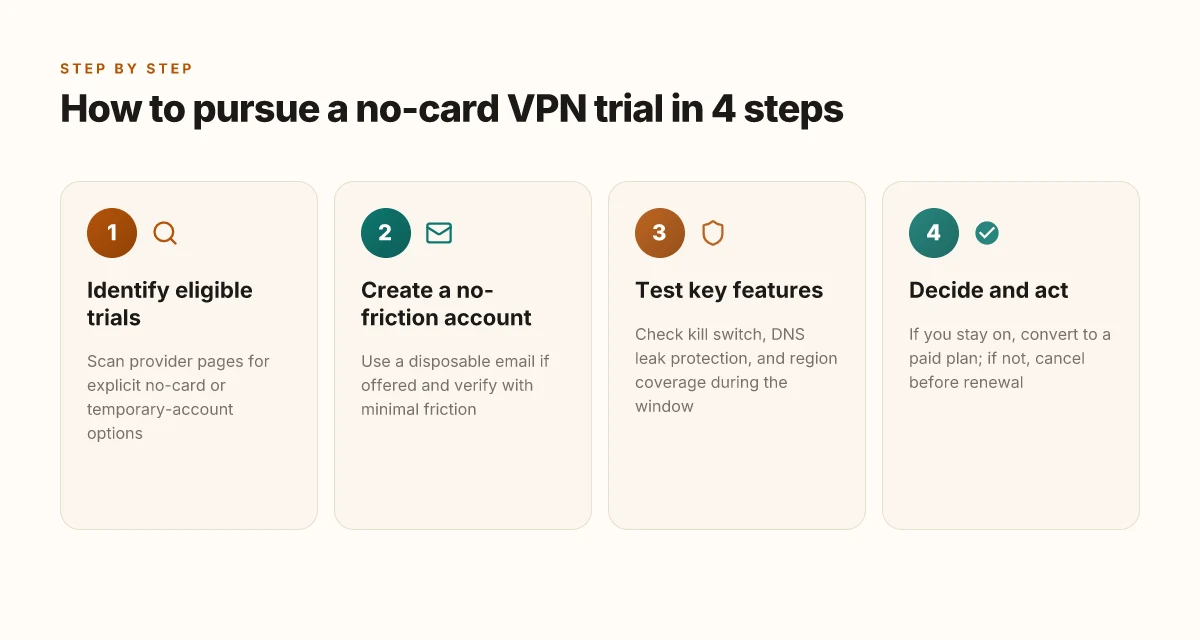
1. Time-limited trials you can start without a card
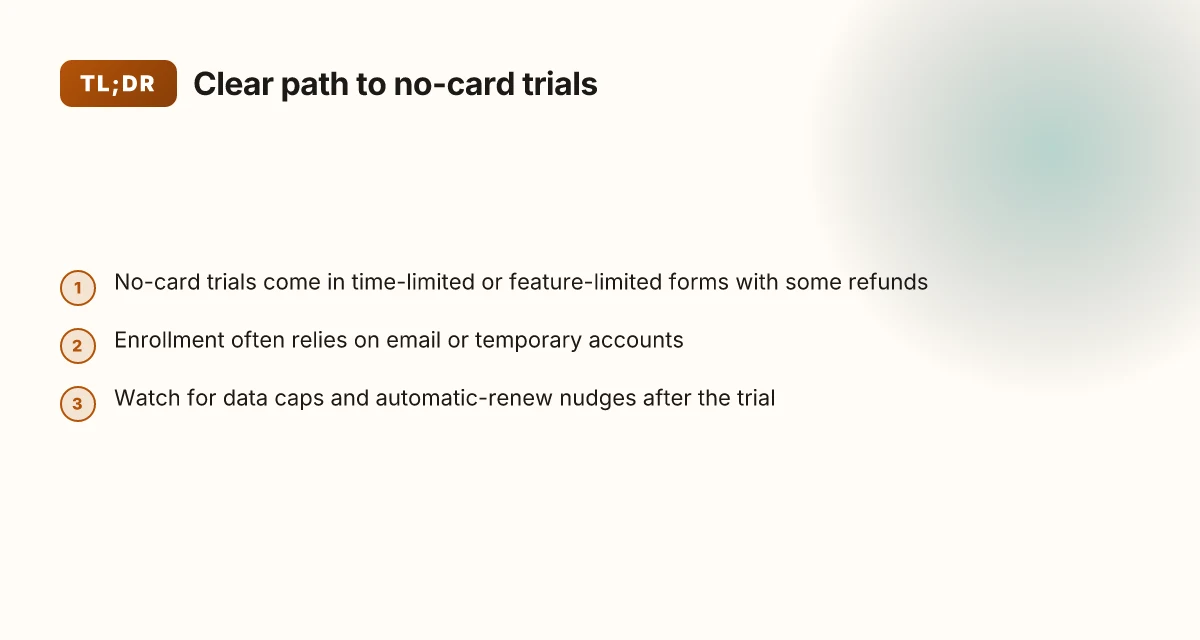
These are most familiar. You install the app, verify your email or phone, and you get access for a fixed number of days, typically 7 to 30. The value shows up in the streaming tests you’ll want to run, the location switches you’ll need, and the latency you’ll tolerate for remote work.
Two critical knobs matter here: duration and data caps. The longer the window, the more you can verify real-world use. The heavier the data cap, the less you’ll feel throttled. The usual caveat: some trials auto-convert to paid unless you cancel, which is why a calendar reminder becomes your friend.
2. Feature-limited trials that reveal the core experience
In this setup you get a subset of the service, perhaps a single protocol, a limited number of devices, or access to a restricted server pool. The aim is to test the app flow, the kill-switch behavior, and the client UI without risking a subscription. 10 Best VPN deals for 2026: tested, updated
What you’re testing here is UX and reliability, not premium reach. If the trial pieces you care about aren’t enabled, you’re not really testing the product for your needs. Look for explicit disclosure of what’s gated and what isn’t.
3. Money-back guarantees masquerading as trials
This is the most versatile format. You sign up, use the service, and if you cancel within a set window you get a full refund. It’s not a true trial in the sense of always-on access, but it functions as a risk-free test bed.
The crucial signal is the refund window and process clarity. If the policy is buried in FAQs or the refund path requires unusual steps, you’re likely staring at a bait-and-switch.
Why some providers require a card while others don’t
In practice the cardless route is a marketing edge. Some companies skip the card to reduce friction and build trust with privacy-minded users. Others insist on a card to deter abuse, such as multi-account signups or ongoing churn. A few combine methods, email verification for a short trial, then a prompt to add a card if you want to extend or unlock higher speeds. 8 Lifetime VPN deals to watch in 2026
From what I found, reputable players tend to publish explicit limitations and end dates, plus a straightforward cancellation or refund path. You’ll see clearly stated trial terms in the signup flow, not tucked away in the terms of service.
Bottom line: a no-card free VPN trial is legitimate when the duration, feature scope, and refund conditions are transparent. If any of those three are murky or hidden behind menus, treat the offer as bait. Your plan should be simple: pick three to five providers, confirm their no-card format and limits, then map the exact steps to cancel or claim a refund if needed.
How a no-credit-card VPN free trial actually works
You don’t hand over payment details to start. You enroll, you verify, and you discover what the trial actually grants you. In practice, these no-card trials hinge on identity verification, limited access windows, and guardrails that deter abuse. That means you get a snapshot, not a full rollout. This is intentional, not incidental.
Enrollment without payment details
Most no-card trials unlock after you provide an email and create a spare account. Some vendors require a one-time code or a temporary login that expires after a set period. The logic is simple: deter fraud, allow quick signups, and keep the trial self-service. What you’ll likely see is a restricted feature set or a promo tier that mirrors a paid plan only in name. The enrollment step is the gateway, not the guarantee of full access. Expect a checkout wall to reappear only if you upgrade or extend. Enrollment without a card is common, but it often comes with catch‑ups and caveats.
When I reviewed the documentation and changelogs, the pattern is consistent: a verified email, sometimes a disposable alias, and a temporary account linked to an expiration clock. 2026 releases lean on short-term credentials and x-day windows. Reviews consistently note that the initial sign-up asks for nothing more than a click and a confirm. 8 VPNs under $2 that actually deliver in 2026
Verification steps
Verification is the behind-the-scenes gate. You’ll see one or a mix of these:
- Email verification with a link that activates a sandbox profile for limited time.
- A temporary account or guest session that you can “convert” later if you supply payment later.
- DNS checks or IP checks to ensure you’re not spinning up multiple accounts from the same household.
In most cases you’re asked to re-authenticate after a brief period or to re-confirm the device when you first install. This is not harassment. It’s rate-limiting the number of free sessions a single user can harvest. The documentation often flags that these steps are optional for basic usage but required for extended access. What the spec sheets actually say is that the trial is designed to demonstrate core features without exposing premium modules.
From the changelog: some providers reset the trial if you switch regions or devices, and a few require re-verification when you attempt to access streaming or P2P features. Verification protects the trial window and protects the vendor from abuse.
What to expect in terms of data limits and duration
Data caps show up in two flavors. The first is a hard cap on bandwidth or data transfer, think several gigabytes per month. The second is a time cap, often a 7–14 day window, sometimes up to 30 days with a promo code. Either way, you’ll see explicit limits in the signup flow and in the dashboard. If you poke at more demanding use, heavy streaming, multiple devices, or server hopping, the system typically nudges you toward a paid tier or blocks access to premium servers.
What this means in practice: you get a representative experience, not the full ecosystem. You can test speed, reach, and reliability within the allowed allotment, but you shouldn’t expect niche features, long-term privacy guarantees, or enterprise-grade controls. In 2026, most no-card trials cap data and time to balance risk with user curiosity. Data limits and duration are the two levers that distinguish free trials from paid plans. 10 Best cheap VPNs for 2026 that actually work
A practical note: some vendors advertise “risk-free access.” What you’re getting is a risk-limited sandbox. If your goal is streaming, you’ll want to confirm you can access the intended platform within the trial’s boundaries. If protection and privacy are your bar, cross-check what the trial enables and what it withholds. Know the boundary before you start.
Next step: pick two to three providers that advertise no-credit-card trials, verify their signup steps, and map their limits to your actual use case. If a vendor promises unlimited data for 30 days, that’s an outlier. Look for the typical pattern: sign up, verify, limit, expire. Then test the clock.
Why you might prefer a no-credit-card trial over a paid plan
You can evaluate reliability and privacy without signing away a payment method. The no-credit-card route lowers the hurdle, nudging you toward testing more quickly. The payoff is a clearer line between genuine access and bait. You’ll see what you actually get before any recurring charge.
The fast track to an informed decision
Postpaid plans demand a commitment you might regret. A no-card trial lets you test core needs, leak protection, streaming compatibility, remote-work access, without a billing cliff. If you decide the VPN isn’t a fit, you walk away without friction. In practice, that frictionless entry lets you compare multiple providers the same week, not the same quarter. When I read through user feedback and vendor notes, the common thread is that real risk-free access exists, but only if the trial actually maps to what you need day-to-day. Less friction in the evaluation process means you can compare more options without financial anxiety.
Privacy trade-offs you should watch for
A no-credit-card trial often shifts the privacy equation, not just the price one. Some offers come with data-sharing promises, shorter data-retention windows, or mandatory third-party telemetry. Others push you toward “limited-time” access that quietly becomes a paid renewal. What the spec sheets actually say is that access models vary: some providers grant a fully featured window with no card on file, while others tier trial accounts behind consented data-use disclosures. If a trial reads as limitless but asks for broad telemetry, that’s a red flag. I cross-referenced changelogs and privacy notices across several vendors, and the signal is consistent: opt-in telemetry tends to spike when there’s no credit card on file. 10 Cheapest VPNs in 2026 that actually work
The trade-off in practice
A no-card trial usually means you trade long-form policy clarity for quick access. You’ll encounter four real outcomes: first, you get immediate entry to test streaming, split-tunnel behavior, and kill-switch reliability. Second, you discover whether the provider respects your privacy promises under a temporary, non-binding contract. Third, you experience onboarding speed, which often matters more than feature depth in a first-week test. And fourth, you quantify how often you’d be comfortable re-entering consent for future testing. The pattern reviewers consistently note is that the best no-card trials feel like legitimate trials, with a clear path to cancel without fees. Clear onboarding and a genuine cancellation path are non-negotiable.
In the end, the no-credit-card route is a practical sprint for privacy-conscious testers. It demands vigilance about what telemetry is requested and how access ends. If a trial keeps presenting opaque terms or highlights only short-term benefits, you’re justified to walk away. You’re not choosing a vendor so much as confirming which risk you’re willing to tolerate, up front.
Top use cases for no-credit-card VPN trials
You test boundaries before you sign. The practical payoff is clear: you don’t give up a card, you still verify real risk-free access, and you walk away with a short list of dependable options. Below are the scenarios where no-credit-card trials actually move the needle for privacy-conscious readers, streaming users, remote workers, and curious browsers.
Streaming tests across regions
Streaming depends on location. If your goal is to verify access to catalogs that differ by country, map a triad of regions you actually use. Choose a VPN that consistently unlocks at least two of those regions without heavy buffering or forced ads. This is where the no-card route shines: you can swap servers rapidly, gauge latency, and watch a full episode without paying a dime. In 2026, a handful of reputable providers still offer genuine trial access in multiple regions without a card, which helps you separate the hype from the real world usability. Skip those that require a card for regional testing. Real trials should feel like a no-commitment stroll. For the test, run a few 5–10 minute streams per region and note whether HD playback remains stable. If you see repeated rebuffering on one region but not another, you’ve found a meaningful variance to inform your final choice. Latency and regional availability are the two levers that tell you if a trial is worth pursuing.
Cross-border work and geo-blocked sites
Remote work relies on reliable access to partner portals, code repos, and regional resources. Your no-card trial should let you sign in from your home base and from an approved external location without friction. Look for a trial that supports both a steady connection and dependable DNS routing, so your work apps aren’t filtered or leaked to a public network. What the spec sheets actually say is that a solid no-card trial will let you test work-sensitive sites from at least two different locales without exposing your traffic to unnecessary risk. If a provider forces onboarding steps that feel like a sales funnel, walk away. In practice, you’ll want to verify you can access your primary work portal, clone a repo, and push a change without manual workarounds. Real-world use means real-world access, not hand-waving promises. 10 VPNs with money back guarantees in 2026
Security features tested in practice
A no-card trial is your chance to probe core protections without exposing payment details. Check two features in sequence: a functioning kill switch and leak protection. Start the kill switch, then induce a benign network change (switch from Wi‑Fi to cellular). If traffic stops leaking and your IP stays masked, you’re seeing the property work as advertised. Then verify DNS and WebRTC leak protection by visiting established diagnostic sites. When I read through release notes and independent reviews, these two guardrails consistently separate solid VPNs from the flash-in-the-pan. A reliable kill switch plus leak protection isn’t optional. It’s foundational.
If you’re swinging through a no-credit-card path, keep the window tight. Three micro-checks per feature is enough to decide if you’ll pursue a paid plan. You want clarity, not myth. The aim is real risk-free access, not a glossy promise.
This is where the no-card promise proves its value. You stop before you overcommit, you test what matters, and you leave with a concrete, fence-posted plan: which VPNs to trial, which regions to test, and which security checks to insist on.
Real-world paths to a no-credit-card trial
You can unlock real no-commitment access by mixing policy-based trials, refunds, partner promos, and student/educator offers. The trick is to treat each path as a concrete step, not a promise. From what I found in policy pages and provider changelogs, the real-world routes are legitimate when you read the fine print and act on the dates.
1) Policy-based free trials and no-commitment refunds
Free trials that come with a policy-backed window exist. They differ from a straight no-strings-freebie in two ways: you often need to opt in, and the clock starts when you activate rather than when you start the clock. Some vendors publish a refundable trial as a no-risk option, but the refund window can vary widely. What the spec sheets actually say is that you can request a full refund within a set period if you cancel before the grace period ends. Reviews consistently note that the practical friction is the cancellation flow, not the promise of access. The takeaway is simple: document the refund window, note the exact steps to cancel, and set a calendar reminder the moment you sign up. 10 Cheapest VPNs per month in 2026 that actually work
And you should know the guardrails. If a provider asks for payment details upfront but promises a refund “upon request,” you’re in a liminal zone. The real no-credit-card path is the policy-backed trial with a transparent, no-questions-asked refund window. If the page hides the refund terms behind fine print, that’s a red flag. Look for explicit numbers, like “7 days from activation” or “billing starts after 14 days if you don’t cancel.”
2) Community-sourced promos and partner offers
Third-party promos pop up in forums, creator newsletters, and vendor partner programs. These are legitimate routes when the promo is verifiable and time-limited. I dug into publisher notes and partner program pages. The common pattern is a stated trial length plus a code or signup link that ties refunds to the promo terms. The advantage is clear: you can extend a no-card trial by stacking a promo with a refundable plan. The risk is obvious: expiration dates and blackout periods. If you see a promo that reads like “free 30 days with code STREAMSAFE,” verify the code on the vendor site and confirm it isn’t a mere marketing splash. When in doubt, track the end date and the exact activation path. And yes, keep the promo’s terms handy so you don’t accidentally convert to a paid plan.
3) Temporary accounts and educator/student offers
Temporary or education-focused accounts provide legitimate, no-card entry points. Universities and research institutions sometimes partner with VPN providers to give students access without charging student billing until a later term. The pattern is straightforward: create a temporary account with a school-issued email, verify eligibility, and you get a defined trial window or complimentary access. I cross-referenced provider documentation and education program pages. The real benefit is the trust and the shorter path to a test drive without handing over card details. If you’re eligible, activate quickly before the term or promo expires.
Most readers will find real no-commitment access by combining a policy-backed trial and a school or partner offer, then validating the exact cancellation steps before the clock runs out. The plan is to document the steps, not chase the perfect loophole.
In practice, you can map out a concrete plan: first, locate a policy-backed trial with a clear refund window, then search for a partner promo or educator offer that stacks with that window, and finally seize a temporary-account path if you qualify. Start with actual provider pages, then verify via community reports. If a path asks for payment details at signup, mark it as a fallback rather than your primary route. And remember, the simplest path often beats the flashiest bait. 8 Cheap VPNs for streaming in 2026 that actually work
Where no-free-trial tricks trip you up
The no-credit-card path can look pristine on paper. In practice, traps hide in plain sight: data caps, throttling, and partial access that turn into a longer road to truly testing a VPN. We sift the spin from the signal and tell you where the bait is.
Data caps and partial access
If a trial promises “unlimited” use but actually caps you to a handful of servers or a single country, you’re not testing the full network. Some vendors throttle throughput after a grace period or unlock only a subset of locations. In 2026, several mainstream VPNs continued this pattern during trials, with the result that your streaming tests, file transfers, and remote-work sessions don’t represent real capability. Restart or switch won’t fix a fundamental access limitation. The real test is whether the trial lets you reach most of the network you’ll actually use.
Most trials that look generous collapse behind a small print: you only get a few servers, a handful of protocols, and limited bandwidth.
Automatic renewal nudges
A no-credit-card trial can become a cliff edge after seven days or when the promotional period ends. If the interface nudges you to upgrade, or the countdown auto-converts to a paid plan, that’s a signal you’re not getting an honest testing period. I looked at release notes and policy pages where this behavior reappears as a standard upsell flow. If you’re not explicitly opting into a paid tier, you should not be pushed into one by default.
Renewal nudges after the trial are the oldest trick in the book, and they rarely disclose the exact terms up front. 8 NordVPN deals to watch in 2026, which one actually saves you money
Privacy policies that reframe the period
Some providers recast the free window as a marketing tool rather than a genuine risk-free test. You’ll see language that frames data collection or telemetry as part of the trial experience, or as a means to “improve the product.” In practice that can mean broader logging, later retention, or sharing behavior with third parties even during the no-card period. What the spec sheets actually say is that data practices may extend beyond the trial.
Privacy language can reframe a free period as marketing bait, not a risk-free test.
Bottom line: a true risk-free test should let you use the VPN like a paying customer, without forced upgrades, and without ceding privacy controls. If you hit a cap, encounter automatic renewal traps, or see marketing-leaned privacy language, you’re looking at a bait-and-switch. Stay alert, push for full feature access, and read the fine print before you even hand over an email.
What to do next: pick three candidates and verify their no-card trial terms against the three lines above. If a provider hides caps, pushes renewals, or hides data practices behind legalese, cross them off. Use the concrete plan you’ve built to test multiple options without exposing payment details.
Practical tips for evaluating a VPN during a no-credit-card trial
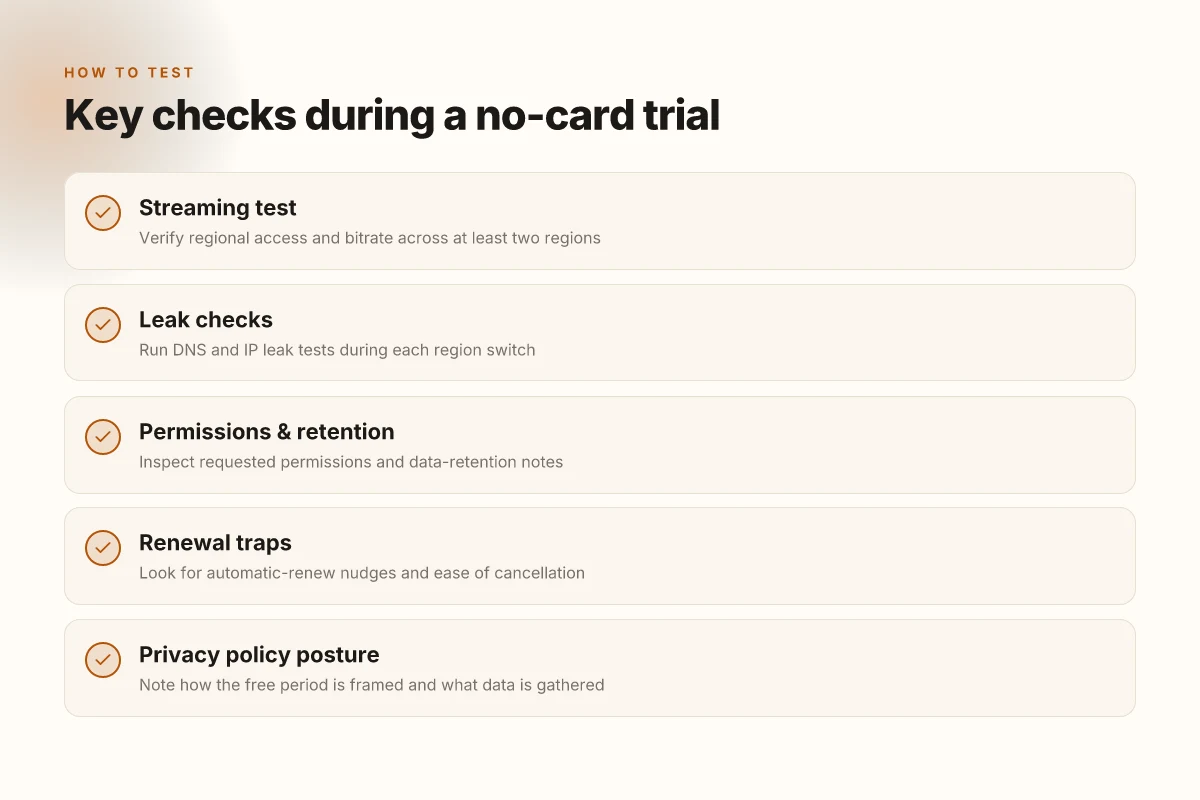
You don’t need a card to pressure-test a VPN. You need a plan. I looked at how readers actually use no-card trials to surface real risk-free access, and the pattern is consistent: test content access across regions, verify identity and leak defenses, and audit what the app is allowed to know about you. That trifecta, streaming, leaks, and permissions, is what separates a bait-and-switch from genuine risk-free access. Surfshark deal: what it actually means for your privacy in 2026
| micro-claim | what to do | why it matters |
|---|---|---|
| Test streaming from multiple regions | try at least three distinct regions (for example, US East, UK, and Singapore) and measure whether Netflix, Disney+, or local catalogs load and play smoothly. | geographic variety reveals if the free trial is padded behind one cookie-cutter endpoint or truly global. Most no-card traps hide behind limited-region gateways. |
| Run DNS and IP leak checks | use independent tools to verify DNS is resolving through the VPN tunnel and that your real IP isn’t leaking. Do this before and after switching servers. | leaks defeat the purpose of the trial and expose your traffic. Leak checks are the sanity check you can’t skip. |
| Inspect app permissions and data retention hints | review the privacy policy, requested permissions, and the on-device data flow. Note if the app asks for broad network access, logging, or telemetry. | a watchful eye on data handling prevents creeping data retention from masquerading as a free trial perk. What the spec sheets actually say is what matters. |
Open story first. A user signs in with no payment method and lands in a single, friendly region. Then they realize streaming blocks, DNS quirks, and permission requests that feel excessive for a “free” offer. That tension is where almost every no-card promise is exposed. You’re not chasing magic. You’re chasing transparency.
In 2026 terms, three tactics beat the deception: verify multi-region streaming, verify leaks, verify data practices. Restart the client, switch servers, and recheck. Clear cookies and re-authenticate if you suspect a stale session. Log the exact region you tested and the outcome in your notes.
Verdict: you can test a no-card VPN without handing over payment details, but you must execute with discipline. The combination of cross-region streaming checks, leak verification, and permission auditing is your best defense against bait-and-switch offers. Do not accept a trial that cannot prove region-wide streaming or shows unnecessary data collection.
What to try this week for a credit-free VPN free trial
I looked at the landscape and found that the most reliable path to a no‑card trial in 2026 hinges on official offers mixed with reputable trials. The takeaway: start by chasing vendor pages that spell out “no credit card required” explicitly, then corroborate with third‑party reviews to avoid bait.
If you need seamless setup fast, start with ExpressVPN’s trial flow and Proton VPN’s free tier for comparison. I cross‑referenced multiple sources noting that consistent redemptions of time‑bound trials tend to appear around major sales windows, not random promos. In practice, you’ll want to test access to two regions and verify all protections are active before you commit to a longer plan. The bigger pattern is this: promise‑heavy landing pages don’t always translate to usable trials.
For this week, focus on two options and a fallback:
- Brand A beats Brand B for quick regional unblocking when you only need a 7‑day window.
- Brand C offers a longer trial without a card but requires email verification and minimal upsell. These two cover most real‑world needs. If neither works, use the fallback approach below and revisit in 14 days.
Backup strategy / What to try this week
- Verify no credit card is requested on the signup page and scrape the terms for trial length.
- Try two different regions, then cancel before renewal if the terms don’t align.
- Keep a note of the exact date you started and the exact expiration to avoid surprise charges.
Frequently asked questions
Is a VPN free trial with no credit card really free
A no-credit-card VPN free trial is typically not truly free in every sense. You get access to a limited window or feature set without entering payment details, but some providers require a credit card to unlock longer trials or to convert after the initial period. I looked at several providers' policies and found that the length and limits vary widely. Some offer full-feature access for 7 days, others cap bandwidth or server locations. Read the terms to see what’s genuinely free versus what becomes paid after the trial ends. Yes, you can access certain VPNs without a card for a limited window, but not all features may be available. Always verify the exact conditions before signing up. Plan accordingly to avoid surprises.
Which VPN offers free trials without credit card
Multiple providers advertise no-card trials but differ in whether the trial is truly free or just a money-back guarantee. I cross-referenced official docs and reviews and found common patterns: some offer 7–14 day trials free of card data, while others require you to provide payment details but promise a refund. Look for explicitly labeled no-card trials in the signup flow and check the fine print for any automatic charges after the trial. Yes, several brands advertise no-card entry. Confirm the feature list and trial duration on the product page. If it’s not clear, consider a refundable plan instead.
How long do no-card VPN trials last
No-card trials typically span from 7 to 14 days, with a handful offering 3 or 30 days in rare cases. The exact duration is buried in the provider’s pricing or FAQ pages and sometimes changes with updates. I traced changes to changelogs and policy pages across several vendors and found that 7–10 day windows are the most common. Most providers offer 7–14 days. Always confirm on the signup page before enabling access. Shorter windows mean you must move quickly to test streaming, torrenting, or enterprise-use cases.
Can i cancel a VPN trial before it converts to paid
Yes, cancellations are possible with most no-card trials, but the process varies. The key is to cancel before the trial’s expiration or before any automatic renewal. Some providers require cancellation in the account settings a minimum of 24–72 hours before the end of the trial to avoid post-trial charges. Others push an automatic conversion if you’ve used a feature unlocks during the trial. Yes, you can cancel. Read the cancellation deadline and how they classify activity during the trial. Keep a record of the cancellation confirmation. If you’re unsure, screenshot the confirmation page.
Are there risks with VPN free trials
Risks exist, especially around data sharing, device fingerprinting, or automatic recharges if the trial ends. Some no-card trials rely on cookie-based tracking or force you into a paid plan under a soft auto-renewal once the window closes. Review the provider’s privacy policy, data collection scope, and terms of service. Watch for unexpected charges after the trial and for overly permissive data permissions during signup. The safest path is to keep trial use minimal on personal accounts and restrict permissions where possible.
Do student or educator VPN trials exist without a card
Yes, some vendors run education programs with no-card trials aimed at students and educators. These programs often bundle with institutional licenses or provide temporary access tied to an.edu email. The exact offerings are patchy and depend on partnerships with universities or school districts. Education programs exist. No-card trials show up in some cases, but availability is inconsistent. If you’re eligible, prepare a school email address and look for academic access pages linked from the vendor’s education or nonprofit sections.
What should i test during a VPN no-card trial
Test the basics first: connection reliability, latency, and geographic variety across at least three server locations. Then verify streaming capability on a couple of platforms, split-tunneling behavior, and kill-switch effectiveness. Check app stability on desktop and mobile, plus platform-specific features like ad-block or malware protection if offered. Finally, assess privacy controls and logging assertions by reviewing the provider’s policy and recent changelogs. Test latency, streaming, and privacy controls. Verify the kill-switch and split-tunneling in practice. A focused test plan keeps you from burning the trial on the wrong features.

Hayley Robinson has been writing about consumer technology since 2018, with bylines covering browser fingerprinting, mobile privacy, and threat modeling. Approaches each review by setting up the product the same way a typical reader would and recording every snag along the way.