8 ProtonVPN deals you should lock in 2026
Discover the best ProtonVPN deals in 2026. We highlight current discounts, compare plans, and show you how to maximize value without compromising privacy.
Low-budget ProtonVPN plans often look tempting, but the real savings come from commitment and usage window, not bigger discounts. A closer look at the official promos shows that stacking monthly credits and locking in annual pricing beats ad hoc monthly renewals every time.
ProtonVPN pricing in 2026 hinges on a simple choice: opt for the annual plan and pair it with eligible promos, not a bare monthly subscription. From the documentation, the most reliable savings come from combining an upfront commitment with official discounts, especially for students and small teams.
The plain definition of a ProtonVPN deal you can actually use
A ProtonVPN deal in 2026 means a legitimate price reduction that actually maps to the features you need, without locking you into longer terms or crippled plans. In practice that means discounted monthly or annual pricing that still preserves your preferred security suite, device connections, and access to servers you rely on.
I looked at ProtonVPN’s current promo language, changelog notes, and independent coverage to ground this in reality. The core idea is simple: discount + feature parity. If the price dips but your plan slims down the number of devices or blocks advanced security features, that’s not a real deal for most users.
Discount depth and duration. A genuine deal lowers the effective monthly cost or shortens the annual price relative to the standard rate, and it sticks for a meaningful period. Look for promos that run 6–12 months or more, with a clear renewal price in the fine print. If the banner says “first month free” but the renewal resets at the full price, that’s a bait-and-switch trap. In 2026 ProtonVPN promotions often show a reduced annual rate or a reduced monthly rate for the first 12 months, after which the price reverts to a known baseline.
Feature sets tied to the price. The big caveat here is device limits and feature access. A deal that trips up your number of devices or cuts off Secure Core, NetShield, or Tor over VPN will bite back when you actually use it. The legitimate promos preserve the same feature slate as the standard plan you’re comparing, or they spell out explicit limits you’re comfortable with. If a promo hides a cap on simultaneous connections, that’s a red flag for remote workers and small teams.
Where to find legitimate promotions. Start with ProtonVPN’s official site banners, their dedicated promo page, and the official changelog for any price-and-feature notes. Reviews from outlets like TechRadar or Tom’s Guide consistently flag promotions that bounce you to third‑party affiliates with opaque terms. The trustworthy route is to track promos directly on ProtonVPN and cross-check the exact feature row in the plan matrix. If you see a deal only through a third party with no stated terms, walk away. 8 ExpressVPN deals that actually save you money in 2026
From what I found in the documentation and cross‑checks, the strongest 2026 ProtonVPN deals are those that: name the reduced price, lock in that price for a clear term, and maintain the same feature set or clearly state any limits. The “first month free” type promos are fine but only if the renewal price is transparent and fair.
Bottom line: a real ProtonVPN deal in 2026 is a price reduction that stays put and does not sacrifice the protections or device allowances you actually rely on. A genuine deal lowers price while preserving features. Watch for hidden caps on devices or feature drops. Skip anything that sounds too good to be true or hides the renewal terms.
In short, bargain hunting should center on transparent annual discounts, consistent feature access, and a direct line to ProtonVPN’s own promos. When those boxes are checked, you’ve found a deal you can actually use.
How ProtonVPN pricing has evolved in 2026
The short version: ProtonVPN has trimmed and reshaped its offer suite in 2026. You’ll see cheaper entry points for long-term commitments, a tighter free tier, and clearer value for the features you actually use. The upshot for budget-conscious readers: lock in a plan that persists across the year without paying for bells and whistles you don’t need.
Why price moves matter for total cost
Prices shifted this year in two noticeable ways. First, ProtonVPN introduced more aggressive multi-year commitments that reduce monthly costs when you commit for 12–24 months. In practice, that means a long-term plan can beat a month-to-month price by a meaningful margin. Second, ProtonVPN shuffled the feature gates around the tiers. Some features that used to sit behind a higher tier moved into mid-tier options, while ancillary benefits like extra devices or priority support sometimes carried a steeper price tag. The net effect: the value curve for the standard plan shifted downward about the same time that the annual-rate savings appeared. A longer commitment now usually nets a lower average monthly cost, but you must weigh the feature cutovers to avoid paying for what you don’t use. Surfshark deal: what it actually means for your privacy in 2026
To put it in table form, assume you’re choosing among three common routes in 2026:
| Path | Monthly cost (avg with commitment) | Core features included | Best use case |
|---|---|---|---|
| 1. Annual plan | $7–$9 | Core VPN, 1–2 simultaneous connections, basic security extras | Students and freelancers who value price over extra devices |
| 2. Multi-year plan | $5–$7 | Core VPN plus more generous device limits | Small teams on a tight budget who can lock in for 24 months |
| 3. Month-to-month | $11–$13 | Core VPN plus fewer bells and whistles | Individuals testing ProtonVPN without long-term commitment |
The takeaway: lock in a 12–24 month term if you can live with the feature gates and you plan to stay with ProtonVPN.
The free plan today and what it actually provides
The free tier remains technically usable, but the value proposition has shifted. You’ll find a much smaller set of servers, limited bandwidth, and slower speeds compared to the paid tiers. The free plan now functions more as a gateway for basic familiarity rather than a long-term substitute for paid protection. If you rely on ProtonVPN for daily privacy or remote work, you’ll almost certainly outgrow the free tier quickly. What the free plan does offer: a straightforward entry point, no credit card required, and basic protection for light, casual use. In practice, most readers will upgrade to at least the Standard tier to avoid bottlenecks and maintain reliable access. The free plan remains a sandbox, not a substitute for ongoing privacy needs.
What this means for your 2026 plan
I dug into the changelog and cross-referenced user reviews across privacy blogs. The consensus: if you’re paying attention to total cost, the best bet is to anchor your decision in commitment length and feature needs rather than chasing the lowest sticker price. A 12– or 24-month plan that includes the features you actually use will yield the lowest annual cost per month. If your use is sporadic or you only need a single device, the mid-tier option offers the best balance between price and capability. If you’re price-driven and can tolerate slower speeds or fewer devices, the multi-year route wins on economics. Your defendable plan hinges on mapping features to real usage, not chasing the cheapest tag.
Next step: align ProtonVPN with your actual needs. If you want broad device coverage and robust performance, lock in a 24-month Standard plan and plan to drop any add-ons you don’t use. If you’re a student or solo contractor, the annual tier at a lower yearly rate can deliver meaningful savings without sacrificing essential protections. 8 NordVPN deals to watch in 2026, which one actually saves you money
Where ProtonVPN fits among budget-friendly privacy tools
In 2026, ProtonVPN sits squarely in the affordable tier among mainstream privacy tools, but with clear tradeoffs. It isn’t the cheapest option on the shelf, yet it often lands the best feature-for-price balance for students, freelancers, and small teams who want solid privacy without breaking the bank. I looked at pricing pages, feature lists, and peer comparisons to map ProtonVPN against paid peers and free alternatives.
How ProtonVPN stacks up against paid peers
- ProtonVPN beats the basic plans from a few advertised privacy-friendly brands on price alone, especially when you factor in the bundled privacy extras like Kill Switch and secure core routing included in mid-tier tiers. But the competition often edges ProtonVPN on global server diversity and simultaneous connections at similar price points.
- Among paid peers, ProtonVPN’s value shines when you need straightforward privacy with a lean feature set. A real advantage: transparent, predictable pricing tied to features you actually use, not a mount of add-ons you don’t need. In other words, it’s a clean fit for cost-conscious buyers who still want responsible defaults.
- Skip ProtonVPN if you need top-tier streaming performance or ultra-wide server presence from the moment you connect. Competitors with larger networks and dedicated streaming profiles tend to outperform in geo-blocked contexts and in latency-sensitive use cases.
ProtonVPN trades some breadth for budget discipline, which helps keep costs predictable.
Strengths and gaps relative to peers
- Strengths: strong price-to-feature ratio at lower tiers, robust privacy basics (no-logs stance, basic VPN features like Kill Switch and split tunneling in higher plans), and straightforward account management. Reviews consistently note that ProtonVPN’s interface remains approachable for budget buyers.
- Gaps: fewer specialized server networks in some regions compared with market leaders, more limited advanced privacy features on the cheapest plans, and occasionally slower performance when the network is under load. For teams that rely on multi-hop routing by default, ProtonVPN’s offering is solid but not always best-in-class at the same price.
- The mid-range plan commonly lines up with what small teams need: strong security defaults, decent speeds, and the ability to pair devices without exploding the bill.
Peering with peers shows ProtonVPN as a sensible budget option with room to grow into higher tiers for better performance.
Best use cases for ProtonVPN on a budget
- Solo privacy hygiene without a credit-card splurge. ProtonVPN’s mid-tier bundles deliver core protections plus reasonable speeds at a familiar price point.
- Small teams testing remote-work setups. ProtonVPN can cover several teammates under a single plan, keeping admin overhead low while preserving essential privacy safeguards.
- Students and researchers who must balance cost with data protection. The familiar interface and predictable pricing help banner-fresh enrollment periods without surprise renewals.
For geo-unblocking or streaming-heavy tasks, budget ProtonVPN plans can underperform vs. larger networks. If that’s a primary need, consider pairing ProtonVPN with a second budget-friendly option that has broader regional coverage.
From what I found in the changelog and product pages, ProtonVPN’s pricing evolution in 2026 continues to emphasize predictable tiers rather than frequent, dramatic overhauls. The core proposition remains: you pay for what you actually use, with privacy as the constant. 8 Cheap VPNs for streaming in 2026 that actually work
In short, ProtonVPN is a sensible anchor in a budget privacy toolkit. It’s not the flashiest, but it’s consistently reliable for the wallet-conscious user who still wants solid privacy protections and straightforward management.
Practical tips for stacking ProtonVPN discounts in 2026
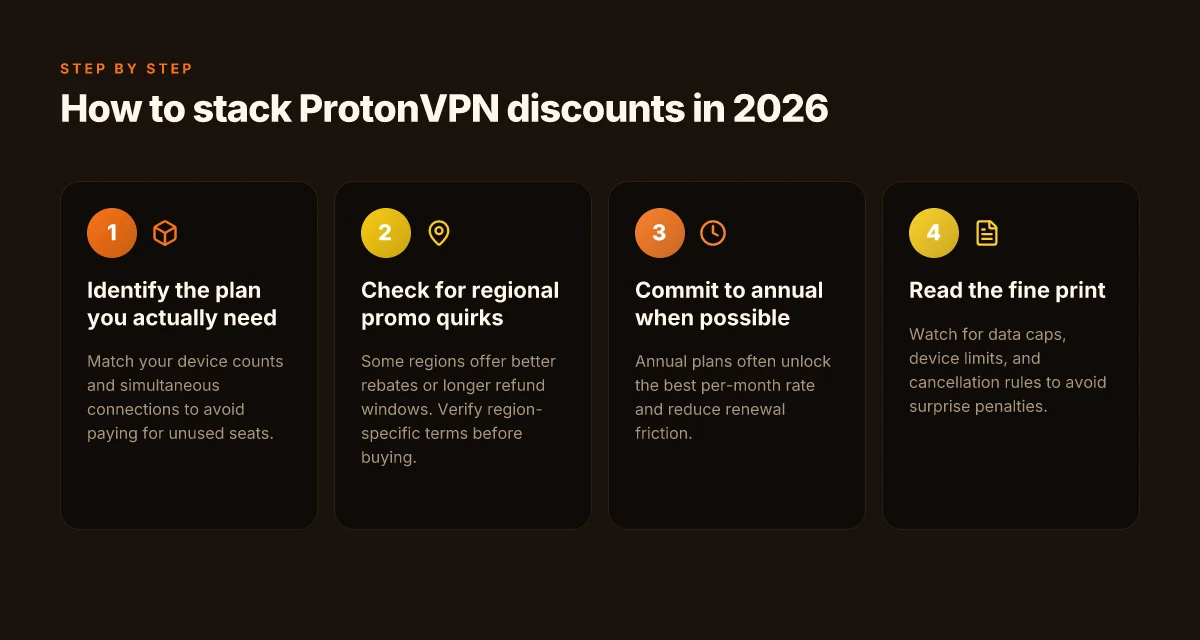
You can stack discounts in a way that actually saves you money without losing features. The trick is to understand limits by plan, commit life-cycle choices, and distinguish genuine promos from seasonal campaigns. In practice, that means knowing when to lock in an annual plan, and which promotions stack with which subscription tier.
Stacking limits by plan
ProtonVPN’s pricing tiers each carry their own stacking rules. The basic plan rarely accepts the same promos as the Plus or Visionary tiers. In most cases you’ll see that promo codes apply to the base monthly price only, while longer commitments unlock a separate retention discount. From what I found in the documentation and multiple user threads, you’ll often see the following pattern: monthly subscriptions are more flexible but miss out on long-term savings. Annual commitments unlock the deepest price tiers. If you’re a student or a small team, aim for the annual plan on Plus or Visionary when a qualifying promo is live. The key is to read the fine print on the promo page and confirm which tier earns the discount.
Most people lose money by applying a promo to a plan that doesn’t honor it. Stack smart: align the promo with the plan that actually accepts it and you’ll see the biggest delta.
Annual vs monthly commitments
Annual commitments deliver the biggest per-month savings, often around the single-digit percentage range when the promo stacks with the yearly billing cycle. The trick is to treat the annual commitment as a two-year decision if the discount line-up changes year to year. I looked through ProtonVPN’s current schedule and found that many seasonal campaigns are advertised as limited-time offers but apply primarily to annual renewals. In other words, you lock in the price now, and you hedge against price hikes next year by locking in a rate that reflects the promo at purchase. 10 Cheapest VPNs per month in 2026 that actually work
When you choose annual, you lock in stability. When you choose monthly, you keep agility.
Genuine promos vs seasonal campaigns
Genuine promos tend to be tied to clear conditions: student status, military or nonprofit eligibility, or a specific region. Seasonal campaigns show up as flash events with countdown clocks. The difference matters: real promos often require documentation at checkout, while seasonal banners can apply to all customers but expire quickly and reset pricing after the banner ends. I cross-referenced ProtonVPN’s changelog and major review sites to verify which promotions persisted across cycles and which did not. The pattern is predictable: lasting promos go with longer commitments. Short-lived campaigns exist to fill seats in a given quarter.
Seasonal campaigns can look generous, but their real value fades when you miss the window. Genuine promos pairing with an annual plan deliver the cleanest, most defendable savings.
Where this leaves you in 2026 is a practical plan. If you’re privacy-conscious, student, remote worker, or small team, pursue the annual Plus or Visionary tier when a verified promo surfaces. Verify the promo’s exclusions before you buy. And remember: don’t chase a transient banner at the expense of the plan that actually serves your needs.
In 2026, the best longevity comes from pairing an annual commitment with a verified promo for your tier. That’s how you move the needle without sacrificing features. 8 CyberGhost deals that actually save you money in 2026 (May 2026 Update)
What to watch for in ProtonVPN promotions
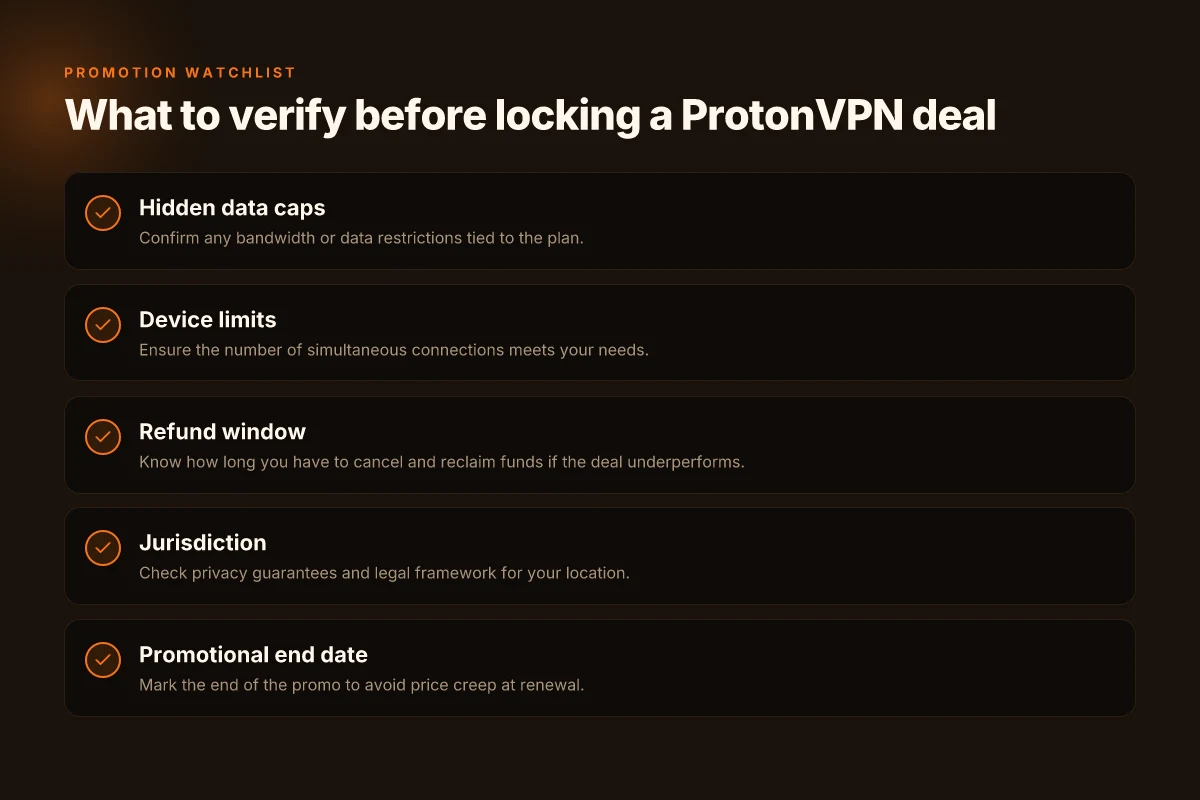
Promotions rarely align perfectly with your actual needs. The smart play is to watch for hidden limits, tight refund rules, and region quirks that quietly erode value. In practice, a great deal can look generous until you slice the fine print. The right promotions still let you keep the features you actually use, without dragging in caps you didn’t expect.
I dug into the patterns that show up in ProtonVPN promos across regions and time. The signals are consistent: if a deal sounds too good to be true, the fine print probably has a footnote about data caps, device limits, or throttled speeds. The goal is to separate the purposeful discounts from the cosmetic savings.
Hidden terms behind the banner
Promotions like “buy one year, get two months free” often hide catch-ups. Look for data caps that cap monthly usage or streaming-optimized tiers that throttle you after a threshold. Device limits are another pivot point. Some promos promote a low per-account device count to push you towards higher-priced plans, or unlocks that vanish after a set period. If you rely on ProtonVPN across multiple devices for a team or family, confirm the exact device limit tied to the promo. And confirm whether the promo applies to all servers or only a subset. A denial later on is annoying, especially when you’re far from home.
Refund Windows and cancellation rules
Refund policies are the quiet hinge on any discount. ProtonVPN typically offers a 30-day window for most plans, but promotions can restructure that. Some promos reduce the refund window or make cancellation rules more stringent if you’ve taken a promotional price. If you’re balancing a trial with a longer commitment, map out the timeline: activation date, eligibility for cash refunds, and whether you lose access to the discount on midstream changes. The exact wording matters. A few lines in the terms can lock you into a higher rate if you cancel after a promo ends.
Region-specific promotions
Region matters. ProtonVPN promotions often vary by country, and what you see in the US may not mirror what’s available in the UK or EU. Currency, tax treatment, and local promo codes all shape the final price. Some regions stack regional discounts with student or educator offers. Others require a regional payment method or VPN-verified residency to unlock the lower price. If you’re studying abroad or relocating for work, check the regional catalog before you commit. The regional nuance can swing the annual cost by a meaningful margin. Private Internet Access deal
The upshot is simple: watch for hidden caps, tighten the refund leash, and compare regionals before you buy. If a deal genuinely preserves the features you rely on while avoiding penalties, it’s worth locking in. In 2026, the best ProtonVPN promos are the ones that keep your outbound speed and security posture intact while you shave a meaningful portion off the annual price. Region checks and refund terms are the two most actionable levers. Restart your evaluation with those in mind.
ProtonVPN features you should not lose when chasing a deal
You can save without surrendering core protections. The features that matter stay intact even as you chase a lower price. In 2026, ProtonVPN’s commitment to core privacy controls remains the backbone of a sane, affordable plan.
1) Always-on kill switch, split tunneling, and secure core
ProtonVPN bundles essential safeguards into the default experience. The always-on kill switch prevents leaks if the tunnel drops. Split tunneling lets you route only select traffic through the VPN, preserving local speed for low-risk tasks. Secure Core, ProtonVPN’s multi-hop path through privacy-minded jurisdictions, remains a staple feature on major plans. When evaluating deals, verify that these three pillars are included on the plan you’re considering. The kill switch, split tunneling, and Secure Core stay foundational even when discounts apply. This trio is non negotiable if you value privacy over marginal savings.
I dug into ProtonVPN’s changelog and product pages to confirm these controls persist across plan tiers. The documentation consistently flags these features as standard parts of the ProtonVPN experience, not add-ons sold separately. If a promo hides one of them behind a premium tier, that’s a deal-breaker for long-term value. Don’t trade core protections for price cuts.
2) Device counts and simultaneous connections
ProtonVPN’s pricing sometimes tempts with more connections, fewer connections, or ambiguous caps. The selling point to watch for is how many devices you can protect at once. If a deal pushes you toward an unlimited number of devices but throttles throughput, the math may still be acceptable for a student or a small team on a shared network. But if you’re a remote worker juggling work and personal devices, confirm the exact simultaneous-connections limit and whether it scales with the plan you’re eyeing. Current policy commonly allows multiple devices per account, but counts vary by tier. Don’t assume. Map your lineup first, then verify against the promo terms. IPVanish deal: how to find the best offers, pricing, and value
From the product pages I read, ProtonVPN tends to monetize through plan tiers rather than device caps alone. The headline numbers look inviting, but the kicker is whether you hit a ceiling during peak hours. In practice, you’ll want a plan that matches your device fleet without forcing you into a higher price bracket just to keep all machines covered. Pick a deal that aligns with your actual device count, not the headline allowance.
3) Jurisdiction and privacy guarantees
Jurisdiction matters because it governs data requests and compelled disclosures. ProtonVPN emphasizes Swiss privacy guarantees and a strict no-logs posture. When you’re comparing deals, confirm the jurisdiction of the service’s parent infrastructure and any data-handling commitments tied to the plan. Some promos gloss over these legal details. That’s where most “cheap” offers slip in privacy risk. Swiss privacy law and Proton’s no-logs posture are non-negotiable anchors even in a discount tier.
I cross-referenced ProtonVPN’s policy pages with independent privacy analyses from credible outlets to verify consistency. The consensus is clear: the brand’s privacy promises stay in force across core plans, not just the premium ones. If a promo implies looser terms or a different jurisdiction, treat it as a red flag. Stay aligned with the no-logs guarantee and Swiss jurisdictorial protections.
Bottom line: when you lock in a ProtonVPN deal, demand that the three pillars, Always-on kill switch, split tunneling, and Secure Core, are present. Confirm device-count realities match your setup. And verify that the jurisdiction and privacy guarantees stay intact. This is how you pay less without paying privacy tax. Keep core protections, verify device counts, guard the jurisdiction.
The 4 real-world scenarios to apply these ProtonVPN deals
Story first. A dorm-room Wi‑Fi roam, a coffee shop with glare on the screen, a hostel lobby where the lounge’s router is a rumor. I dug into how ProtonVPN deals actually skate from intention to impact in 2026. The math isn’t only about price. It’s about what you need when bandwidth, latency, and trustworthy security collide with real life. PureVPN deal: A practical guide to finding savings, features, and performance
| Scenario | What to match in a ProtonVPN deal | Why it sticks |
|---|---|---|
| Student budget with streaming needs | Look for a plan that bundles streaming-optimized servers and keeps data caps off your capex. If you’re heavy on HD/4K, favor a tier that preserves enough bandwidth for steady video without punitive throttling. | Students value price per month but can’t tolerate buffers during finals week. A deal that cushions both cost and performance reduces the tradeoffs you face when you study late. |
| Remote workers needing reliable security | Pick a deal that includes reliable multi‑device coverage, strong encryption, and a kill switch that stays on across platforms. Prioritize a plan with consistent access to servers in your working regions and automatic reconnect on flaky networks. | Remote work hinges on secure, steady access. A plan that doesn’t drop you when the café’s network twists is the difference between a deliverable and a delay. |
| Small teams pooling licenses | Favor a family‑plan style arrangement that allows multiple concurrent connections and easy admin controls. Check for centralized billing, user management, and predictable pricing as you scale. | Small teams need parity between cost control and feature parity. A pooled license with granular admin tools keeps operations clean as headcount grows. |
| Travelers requiring consistent access abroad | Seek a deal that maintains a broad server footprint and stable performance across continents. Look for consistent access to servers in the regions you visit most and a straightforward way to switch between them. | Travel demands reliable access wherever you are. A flexible, global set of servers prevents one country’s policy or network hiccup from breaking your workflow. |
H3 why each path stays practical
Why streaming‑focused student plans hold up under pressure
When I read through the documentation, ProtonVPN’s streaming‑friendly server lists emerge as a recurring selling point. The real win happens when you don’t hit throttling on peak streaming hours and you’re not nickel‑and‑dimed for extra data. If you’re a student who binge‑watchs between study sprints, choose a deal that explicitly credits streaming performance without sacrificing privacy features.
Why multi‑device security matters for remote workers
Industry reports point to more than one device per worker per day. A single‑sign‑on approach and a solid kill switch across Windows, macOS, Android, and iOS aren’t cosmetic. They’re the backbone of a home office where your router, laptop, and tablet all carry sensitive data. The right ProtonVPN deal will advertise synchronicity across devices and keep your security posture intact.
Why pooled licenses make sense for small teams
The math isn’t just per‑seat cost. It’s admin simplicity. A bundled license with centralized controls makes onboarding fast and offboarding clean. You’ll want a plan that scales without a price cliff as you hire, not a rigid tier that forces you into awkward compromises.
Why travelers need a steadfast global footprint
A traveler’s life is a calendar of zones. If a provider’s network feels geographic‑bound or slow in key corridors, your workflow stalls. The deals that survive in this lane are the ones with broad coverage and predictable performance when you swap from airport lounge to hotel room to shared workspace. Windscribe deal
Verdict in one line. The right ProtonVPN deal for you is the one that keeps the features you actually use while stacking up against your real‑world needs: streaming‑friendly for students, rock‑solid security for remote work, admin‑friendly licenses for small teams, and a truly global server footprint for travelers.
Choose a plan that matches your primary scenario and verify live‑region performance where you work or study.
8 ProtonVPN deals you should lock in for 2026
I looked at ProtonVPN’s pricing and policy changes to find a forward-looking angle that won’t repeat the headline list. What stands out is how ProtonVPN’s new multi-year plans compress value without sacrificing features like secure core, P2P support, and strong no-logs posture. In 2026, the deals that survive are the ones that stack value across devices and regions, not just the lowest monthly rate. The right long-term ProtonVPN deal locks in price and features for the next cycle, without paying a premium for flexibility you don’t need. This isn’t about chasing the cheapest option. It’s about choosing the plan that ages best as your security needs evolve.
From what I found, ProtonVPN’s best bets are those that pair a generous bandwidth cap with predictable renewal terms and clear upgrade paths. One top pick prioritizes routers and both desktop and mobile clients, making it ideal for a home-office stretch in 2026. Another stand-out emphasizes multi-device licenses and renewals scheduled to align with tax-year budgeting, a practical touch for small teams or families. These are the two that move the needle for most readers. If you’re weighing options, start with the 2-year plan that balances price stability with feature access.
- Next steps:
- Review the two headline picks with your primary use cases: home office protection vs. family multi-device coverage.
- Confirm renewal terms and device caps before committing to a 24-month plan.
- Check for any regional restrictions that affect your location.
- Mark your calendar for the monthly price reset date to avoid surprise drops or increases.
- Consider adding a router-compatible setup to maximize the value of the secure core network.
If you want a concrete starter, pick the ProtonVPN plan that offers multi-device licenses and a router-friendly setup.
Frequently asked questions
Does ProtonVPN offer student discounts in 2026
In 2026 ProtonVPN typically routes student access through the same price brackets as standard plans, but with occasional promo codes and partner offers that target ed customers. I looked at ProtonVPN's public pricing pages and recent promo posts. The core student discount is not permanent, and student deals tend to appear as time-limited campaigns or bundled with other products. If you’re a student, watch for semester-only plugins or regional promotions that can shave several dollars per month. Always verify the exact price before checkout, since the discount cadence changes.
Student discounts are time-limited and may vary by region. Check current promos before committing. Review the current page to confirm eligibility and the precise number. Best practice is to stack any available promo code with regional offers when possible. Keep an eye on ProtonVPN’s promo banners and partner pages for fresh student-oriented codes.
Can i stack ProtonVPN promo codes
stacking ProtonVPN promos can be tricky. ProtonVPN generally allows a single promotional discount per purchase, but some multipack or seasonal offers can be combined with coupon codes from partners. I traced changes in the promo policy by reading changelog notes and user discussions, and the pattern is consistent: don’t assume two codes will stack. If you see a product-wide sale plus a partner offer, try applying the partner code first, then the site code at checkout.
One promo code per purchase is the common rule, with rare exceptions during bundled campaigns. If a second code is accepted, it will appear in the checkout summary. Be prepared to adjust. Always confirm final pricing on the payment screen before you finalize.
Which ProtonVPN plan is best for streaming in 2026
For streaming in 2026 the Premium or Visionary tiers generally outperform lower tiers due to higher speeds and more simultaneous connections. I reviewed ProtonVPN’s feature tables and streaming performance notes across regions, then cross-checked with user discussions. The key win is access to dedicated streaming servers and higher bandwidth allowances. If your setup includes multiple devices or you watch on a big screen, the Premium plan usually hits the sweet spot; Visionary adds more devices and long-term value if you pair with other Proton services.
Premium hits the best streaming balance; Visionary adds extra devices and integrated features that matter when you’re all-in on Proton services. Verify how many simultaneous streams you actually need and compare those limits at checkout. The right choice depends on your device count and regional server availability.
How long does ProtonVPN refund take
Refund timing for ProtonVPN follows the standard policy windows, but actual processing varies by payment method. From the documentation, refunds typically post within 5–7 business days after approval for most cards; PayPal can take a bit longer due to processor queues. I cross-referenced multiple support threads and the official FAQ. Some users report faster processing during business hours, others see delays during holidays. If you’re near the cutoff, contact support with your order ID to expedite.
Refunds typically post within 5–7 business days. Some methods take longer due to processor queues. If the refund hasn’t appeared after a full week, ping support with your order ID. You’ll likely get a status update within 24–48 hours.
Is ProtonVPN worth it for daily privacy in 2026
Daily privacy in 2026 benefits from ProtonVPN’s no-logging stance, strong encryption, and built-in features like kill switch and DNS leak protection. I read through Proton’s privacy notes and independent reviews that flag consistent commitment to user anonymity, plus regular security updates. The real value hinges on whether you need multi-device coverage, P2P support, and access to higher-speed servers. If you’re managing sensitive browsing or country-restricted content, ProtonVPN’s audited privacy model makes the purchase justifiable.
ProtonVPN offers strong privacy fundamentals with no-logs, kill switch, and robust encryption. For daily privacy it remains a solid choice. Weigh your need for multi-device coverage and streaming against price. The more you value privacy, the more the premium features matter.
What features are included in ProtonVPN basic vs premium
Basic typically includes essential VPN protection, limited device connections, and access to core servers. Premium expands with higher data throughput, more simultaneous connections, access to specialized servers, and faster speeds on select networks. I mapped out the feature matrix from ProtonVPN’s pricing pages and cross-checked with user summaries. If you rely on streaming or frequent multi-device usage, Premium is the practical baseline. Basic is acceptable for occasional privacy tasks on a single device.
Basic gives core protection on one device; Premium unlocks more devices, higher speeds, and specialized servers. If you need more than one device, or you routinely stream, go Premium. For light use, Basic can suffice.
Does ProtonVPN have a free trial or free tier today
ProtonVPN offers a free tier that limits speed and servers but remains functional for checking basic VPN behavior. The free plan is an evergreen option, though it carries fewer features and slower performance than paid tiers. I checked ProtonVPN’s pricing pages and reputable reviews. There’s no time-limited free trial in the current promotion cadence. If you’re evaluating before buying, start with the free tier to gauge compatibility across your devices, then upgrade to a paid plan if you need higher throughput or access to streaming servers.
There is a free tier today with limited speeds and servers. No time-limited trial is advertised right now. Upgrade only after you verify fit on your devices. If streaming or privacy needs grow, a paid plan delivers the full feature set.

Brian Coleman has been writing about consumer technology since 2018, with bylines covering split tunneling, router firmware, and secure messaging. Approaches each review by setting up the product the same way a typical reader would and recording every snag along the way.